Showing posts with label travel. Show all posts

Sunday, December 30, 2012

An eventful few months

This is a personal post, meant to update the people who actually read my blog whom I may not have met in some time.

[Yes, as odd as it may seem to the people who read my blog for my insights into current affairs, this blog still does serve the purpose of a journal of my thoughts and experiences =)]

I ended a brief relationship a few months ago. It was my first real relationship. I learnt a little about myself, but more importantly, I learnt with certainty that I need not be in a relationship to be happy. It would be nice to have someone of course, but to be with someone with whom things are not working out should not be a goal to aspire to in itself.

M., if you are reading this, I do treasure the moments we spent together. It is rare for me to put into words in the public domain an intensely private experience, but here it is. I should not allow the moment to pass before the desire leaves me.

It means something to me that you touched my life in a positive way. If nothing else, being with you gave me a push to move forward in my life. When things ended between us, I told you that I did not learn much about myself that I did not know already, and that is true, but I did grow from our time together.

Perhaps it is true that we prepare our previous partners for better relationships ahead of them in the future. If so, I hope that I left you with something that will enrich the relationship with whomever you will be (or are) with.

___


I passed another one of the actuarial exams which I had taken in October 2012. Results were released less than two weeks ago. Another step to qualification as a Fellow in my plan to complete a career transition from research engineer to actuary.

The result was not unexpected; I generally know once I see the exam paper on test day itself whether a pass is in the offing or not.

___


I found a new job. Surprisingly enough, it was the job with the very selective requirements that I blogged about in a previous post.

Turns out one interview (albeit a very long one at two hours) was enough to cement their confidence in me.

After a number of career setbacks, it was a strangely affirming experience to have someone else validate my view of my own abilities. It also didn't hurt that the new job came with a large pay rise that exceeded what I used to draw as an engineer.

Then again, perhaps it was because my new bosses are American and new to Singapore. Unlike other hiring managers in the industry, they did not have the convenient fallback of hiring only from a pool of people of known quality that they already knew, as I blogged about previously.

___


I'm currently in progress on a personal project that may or may not help in my new job. Learning Python and the Django framework to allow me to build database driven websites.

This was related to a project proposal that I had submitted which unfortunately did not get funded. However, that doesn't necessarily mean the project will die.

In time to come, with the skills that I intend to acquire, I may embark on the project on my own anyway.

___


After a hiatus of a few years, I returned to the Pokhara valley in Nepal for two weeks of advanced paragliding lessons. Sarangkot beckoned.

I was originally signed up for an SIV course (Simulation d'Incidents de Vol -- french for Simulated Incidents in the Air).

For a good idea of SIV, see this video. It's not a course for the faint of heart; it involves simulating adverse incidents in the air and learning to recover from them under radio instruction. Basically, doing all the things you are NOT supposed to do while in the air. Ironically, this makes you a much a safer and more confident pilot, now that you know the limits of your glider.

For safety reasons, SIV is almost always done over a large water body, like a lake.

Well, I bailed on the two friends of mine who were also doing the SIV course. Instead, I found out about and switched to a concurrently running thermalling course which I thought would be better for my development as a pilot.

As it turned out, the thermalling course involved learning some SIV maneuvers as well. Looks like I would get plenty of opportunity to scare myself as well.

Only the SIV pilots got to do the really scary stuff: spins/SAT, full stall/backfly and reserve parachute deployment.

However, I had the same opportunities to do frontal collapses, asymmetric collapses, B-stall, dynamic turns and wingovers.

Bottom line: Amusement theme park rides now hold absolutely zero appeal. My adrenaline threshold just got raised again.

Sunday, May 2, 2010

The flaneur's guide to dining alone

Rebecca Lynn Tan had an article today in the Sunday Times on Dinner for One. That will be the topic for today's post. Tan's wasn't a bad article, but I think I can provide more ... specific advice on dining alone.

In my youth (ok, I'm not that old), I used to travel fairly extensively as a student. Because it was somewhat difficult to find people with the same travel interests as myself, I frequently travelled alone. Still do, actually. So I learnt a few tricks on dining alone.

Dining alone in a restaurant is, for most people, an intimidating experience. "Table for one", "Yi wei" ... no matter how you say it, it's difficult. As a traveller, I started out ta-paoing from convenience stores, or eating grab-and-go street food, or stepping into a McDonald's like most less experienced travellers. Fastfood is frequently the easiest option when you are in a foreign city and you don't speak the language.

But it got old fast. So I wised up. And I picked up the courage to say "Table for one, please".

The unexpected thing is, the tricks I learnt while travelling still stand me in good stead here in Singapore. It doesn't happen often, but I occasionally dine alone in a restaurant in Singapore. As an incidental benefit, dining alone usually means looking for quieter places to eat; that's a good thing seeing as how I'm allergic to crowds.

Here then, are my tips for dining alone:

  1. First of all, in reference to Tan's article, if you have to raise your voice and repeat "Table for one" to the maitre'd, thereby announcing your solo status to everyone in the restaurant, you're not doing it right. Do what the Japanese do when dining out; indicate with your fingers how big your party is. In this case, just raise your index finger (not the middle one, no matter how tempting that is).

  2. Eat early or eat late, but do not eat when everyone else is eating. Restaurants are at their most crowded from 7pm - 9pm, with exceptions in certain countries (e.g. Spanish diners eat notoriously late). Walking into the restaurant at 6pm or at 9pm will more likely get you the seat you want as well as a more private dining experience.
  3. Fine dining, despite what Tan's article would suggest, is generally not a fine option. Fine dining establishments typically turn tables once, or not at all, per night. Turning tables is restaurant parlance for seating new diners at a table vacated by a prior group. Most diners at fine dining establishments will come in at about 7 or 8pm, and leave after 10pm. So such a restaurant will on average serve a number of customers 1.5 to 2 times their maximum seating per night. If you're a solo diner taking up a table meant for 3 or 4, and you finish sometime after 8pm (especially if you didn't abide by rule number 2), since solo diners seldom linger, it's unlikely that the restaurant will be able to accommodate a new group for your table for the rest of the night. In other words, it's lost revenue for the restaurant. And being a solo diner, it's unlikely that you ordered wine, at least by the bottle. Which is another lost revenue opportunity. They can say what they want about welcoming and making solo diners comfortable, but really, fine dining restaurants generally do NOT want solo diners. Plus, do you really want to sit down through a multicourse dinner alone? And drinking wine alone is ... well, you could either be construed as being very sad or a lush, neither one of which is very appealing.
  4. Cuisine matters. Certain kinds of cuisine are just more suitable for solo diners. Tan was right to be apprehensive about Chinese dining; it is communal and has larger portions or platters meant to be shared. While I do not doubt that Crystal Jade as mentioned in the article has single portions on its menu, still, Chinese is seldom a serious option I consider when I eat out alone. Even if there are single portions available, it's invariably a little more expensive and generally not very good value. The food was meant to be shared after all. The same goes for Thai food. In contrast, Japanese (with its bentos), Korean (think soon-dubu jigae and the like), Vietnamese (Pho, with a sider order of spring rolls or another appetizer), are generally better options for solo dining. Go for cuisines that emphasize individual plates or small portions (Spanish tapas comes to mind, although frankly, there are no good Spanish restaurants in Singapore).

  5. Now, where to eat? That goes right to the heart of the matter, doesn't it? As a diner, I look for good food at reasonable prices. As a solo diner, I ask for quietness and privacy. That may or may not be what you are looking for. If it is, then read on. If not, well, Singapore's a crowded city, so you should have no problems finding what you need. Generally, convenience implies crowds. So if you want to dine someplace quiet, you should be prepared to go a little out of the way. Choose restaurants in out of the way malls (I stay in the west, so West Coast Plaza is one of my preferred haunts. It helps that they have a Sakuraya Fish Market.). Walk out of the hubs like town centers and major MRT stations into surrounding neighborhoods where there are sometimes friendly, family-type restaurants that serve the residents in the area. Hotel restaurants are a safe, if boring and pricey alternative, and the wait staff are used to dealing with solo travellers. And don't overlook tourist destinations. Museums these days are paying greater attention to their food offerings; it would hardly do to leave visitors with a bad taste in their mouths, literally. If you're lucky, you might find a elegant quiet experience in a museum restaurant or cafe. And theatre restaurants can be a godsend for a solo diner. If you step in just after a major show has begun, you're almost certainly guaranteed a quiet private dinner. 

  6. Bring a distractor if you must, or enjoy the experience of dining alone. By distractors, I mean a magazine, a newspaper, a Kindle, or an Iphone ... but probably not a paperback or hardback book. That would look ... odd. And if you're secure enough or inquisitive enough to put aside the distractors, enjoy the experience of dining alone. Too often when we eat out, we are too busy having a conversation with friends or family that we don't appreciate the decor, the restaurant, or just the opportunity to people-watch in the restaurant. Get a seat with a good view of the restaurant, or next to a window that overlooks the street. You'll be surprised by how much you can see, or eavesdrop on.

  7. Lastly, be friendly and be an easy customer. Don't make things overly difficult for your servers. You don't have to engage the wait staff in a conversation if you don't want to, but be pleasant and gracious. And if they are wearing nametags, make a point of addressing them and thanking them by name when you are about to leave. In my experience, people always react well to that.

Saturday, January 16, 2010

Nepal, Winter 2009, Part 4

As transcendent an experience as my first flight was, I flubbed my first landing in a most inelegant way.

Throughout the course, we flew under instructions communicated to us via small radios clipped to our harnesses.

On the final glide of my first flight, I veered too far right despite repeated instructions from my instructor to head left. Looking back, I think it was because I had fixated my gaze on a couple of horses in front of me diagonally on my left. Thinking that I would crash into them, I maintained my course when on hindsight, my instructor probably meant for me to head left, which would eventually put me farther left of the horses.

The end result was I landed in a less than ideal patch of rice paddies. Well, more like ankle deep in mud rather. Oh, and I startled a *huge* water buffalo resting in a muddy rice paddy on the way down. That was quite a sight, according to my fellow students watching from the hilltop. I had just a few seconds to appreciate the sight of the buffalo lurching to its feet and lumbering away from the intimidating red and black glider that was hurtling towards it. Too bad I couldn’t take any pictures of that. Too busy landing.

Despite that initial flubbed landing, the rest of the paragliding course proceeded smoothly enough. We never returned to Kahun Danda after that day, and the rest of our flights were from atop a high ridge called Torrepani, near the main take-off sites for experienced pilots at Sarangkot.

Here are some pictures of the view from the take-off point.

This is one of Fishtail Mountain (Macchapucchre), the iconic peak associated with the Pokhara Valley.


This is one of the Pokhara Lakeside, close to the LZ, a rice paddy field far down the ridge. A flight from Torrepani takes approximately 25 minutes to glide down to the LZ. Longer if the pilot engages in soaring flight.


This is a pic of the us at the LZ heading back to the jeep after an afternoon flight.


A pic of the take-off point from the LZ.


In total, I logged 13 flights during the course, over 6 flying days, for the total of about 3 hours of airtime. After learning how to get into the air safely on the first day of flying at Kahun Danda, the rest of the course was spent doing 2 flights a day from Torrepani, with each flight focusing on a specific set of exercises. We did turns, pitch control, roll control, rear-riser steering, big ears … all the exercises beginner pilots perform to get their licence. Everything proceeded smoothly.

There was a bit of a scare one day though, when one of the students experienced a spontaneous asymmetric collapse of her wing; part of one side of her wing deflated and lost pressure. Naturally, this is a BAD THING to happen. But fortunately, student wings are very forgiving and the wing spontaneously re-inflated after a few seconds, with no change in course. That certainly gave everyone something to think about on the final day though, when we ourselves deliberately simulated an asymmetric wing collapse by pulling hard on the front riser. As safe as the procedure is to attempt on a student wing, one student’s opinion that “I was shitting my pants when I was doing it” wasn’t exactly exclusive to him. It did make for a great confidence building exercise though.

All in all, paragliding in Nepal was everything I had expected of it and more. Nepal really is paragliding heaven. It wasn’t just the perfect conditions and the beautiful scenery or the fact that it was in Nepal, one of the world’s great adventure destinations. What made the trip so enjoyable were also the great people I met on the trip: the students, the instructors, other travelers, and the other more experienced pilots. The world’s best pilots come to Nepal to fly every season, and sitting in Maya Devi Village, the place where pilots chill out between and after flights, one is often treated to amazing acro displays by skilled pilots. Sometimes even with birds of prey. Despite originally starting out with the intention of just attending a student course to learn how to fly, it was inspiring to see so many good pilots honing their skills in the mountains of Nepal.

It was a good trip indeed.

Thursday, January 14, 2010

"In Spain, A Delicacy Rooted in Earth and Tradition"

There is no question that jamon iberico de bellota is the absolute best ham there exists on this planet. I sampled some of it in Spain years ago, in the little pueblo blanco of Ronda, and the memory of its flavor is indelible. The natural sweetness and flavor of the meat was unsurpassed, and the paper thin slices of it had that pleasant slightly chewy texture of well-cured meat.

From The New York Times
By PAOLA SINGER
Published: January 17, 2010


AS we sauntered up the steep, narrow cobblestone streets of Cáceres in western Spain, it wasn’t hard to imagine life there in the Middle Ages. Night was falling, and before us were Gothic churches, Roman arches and Moorish towers, glowing in the soft light of lanterns. It was an arresting sight, but our thoughts soon veered elsewhere — to food and the sumptuous meal we were anticipating. 

Most people travel to this ancient city for its architectural treasures; my friends and I had come to eat pork.

Minutes later, we faced an encyclopedic list of traditional dishes at El Figón de Eustaquio, a family restaurant with jacketed waiters and white tablecloths. For starters, we had a plate of jamón Ibérico de bellota — cured ham made from acorn-fed pigs, which is the regional specialty — plus a round torta del casar, a creamy sheep’s milk cheese enveloped in a hard curd, and giant locally grown white asparagus. 

Though I considered the herbed pork sirloin as an entree, my friend Joan insisted we order the esoteric-sounding secreto Ibérico, or Iberian secret. This simply presented pork filet, we later learned, comes from a special cut near the front leg that’s interspersed with very thin layers of fat. After making all sorts of silly jokes about the curious name of this dish, we ate in complete silence. It was incredibly tender, subtly seasoned and simply delicious. 

Cáceres, in the Extremadura region, is in the heart of Spain’s pig country. I had traveled there in search of the world’s best ham, a recent food obsession instigated by Spanish friends. Along the way, I discovered a variety of mouthwatering specialties, learned about unique traditions and met locals with a contagious passion for their culinary heritage.

As people’s knowledge and love of Spanish cuisine grow, delicacies like jamón Ibérico de bellota are entering the international spotlight. This time-honored ham arrived in the United States in 2008 to much fanfare. Sold for about $200 a pound at specialty stores like LaTienda.com, it became the most expensive cold cut in the country. Discerning consumers seem eager to pay this lofty price. This summer, the powerhouse brand 5J (Cinco Jotas) plans to enter the American market, joining the U.S.D.A.-certified producer Embutidos Fermín. 

“Iberian pork meat is extraordinary,” Ferran Adrià, the acclaimed chef at El Bulli, a three-Michelin-star restaurant in Catalonia, said in a phone interview. “There’s nothing like it elsewhere in the world. There’s a great difference between a superior ham and all the rest.”

The secret of this superiority rests in the thousands of acres of dehesas — mountainous meadows populated by oak trees — where the indigenous black Iberian pigs have roamed since ancient times. They feed on grass, fruit and, most importantly, acorns that fall every autumn from holm and cork oaks. This gives their meat a unique nutty flavor and a high level of oleic acids, considered a healthy fat.

Spaniards take this food tradition seriously. More than 40 million cured hams were sold last year in Spain, and those derived from Iberian pigs are a particular source of national pride. Local residents started curing meats more than a thousand years ago, eventually turning the craft into an art.

Our sybaritic journey started in Salamanca, 130 miles west of Madrid. This lively city marks the unofficial beginning of the Iberian ham trail, which stretches roughly 300 miles down to Seville. My travel companions — María, an effusive Madrileña who drove expertly over cliff-hanging roads, and Joan, an adventurous Catalan who helped us discover the Iberian secret — were old friends and fellow carnivores.

After a brisk tour of Salamanca’s historic center and its lovely Plaza Mayor, we defied the custom of savoring one’s meals and ordered a few appetizers to go. We had an important appointment 30 miles south, in Guijuelo, a small town of dowdy, low-rise buildings and old-fashioned ham shops. I had arranged to visit several ham producers on our pilgrimage, and this was a required stop: the headquarters of Joselito, considered the Dom Pérignon of hams. 

Joselito’s owner, José Gómez, on first impression a laconic man, spoke long and fervently about the 100-year-old empire founded by his great-grandfather. “My customers are not concerned with price; they ask for the best,” he said. “The three key elements are breed, diet and curing.” 

While touring the company’s building, I received a master class. Each leg of ham spends about nine days covered in salt; it hangs for weeks in winter temperatures, so the salt penetrates deeply, then for months in summer heat, prompting a “sweating” process by which the fat further permeates the muscle fibers. This happens in cavernous chambers devoid of machinery, where windows are opened or shut depending on winds and humidity. When summer ends, the hams are moved to a dark cellar where they age for two or more years, intensifying their aroma and flavor, much like a fine wine. 

Joselito uses only hogs that are 100 percent Iberian. A whole leg, aged three years, starts at $1,000 in Spain, about $50 a pound. (Not all hams called Ibérico are acorn-fed. The label must include the word bellota.) In spite of so much tantalizing talk amid mesmerizing rows of sweet-smelling hams, no amuse-bouche was offered, and we left with empty stomachs. It was only later, savoring our memorable dinner in Cáceres, that we quelled our cravings.

After a good night’s rest at the NH Palacio de Oquendo, a renovated 16th-century palace in the old quarter, we had breakfast alfresco on the edge of the main plaza. Nothing beats a good cortado, the strong Spanish coffee, before a long drive.

The curvy, oak-lined southern roads led us to Jabugo, a village of plain white houses that lives and breathes jamón. There I met Maximiliano Portes, who in 2002 created the online brand Maximiliano Jabugo. His customers, he said, are everyday people who order airtight, pre-sliced cold cuts. Modern marketing notwithstanding, the only way to achieve high quality is through a slow, artisanal curing process. Mr. Portes’s hams hang in a thick-walled cellar, where meat has been cured since 1900. In fact, Jabugo’s quiet cobblestone streets, dotted with modest bars where local workers meet for afternoon drinks, showed no signs of modernity.

As we headed back north to Badajoz, a heavy rain slowed us. By the time we reached Rocamador, a rural hotel and restaurant in a 500-year-old former monastery, it was 11 p.m. and our stomachs were growling. Thanks to the Spanish custom of late dining, the kitchen was still open.

Though I was tempted by pork cheeks in a creamy vegetable sauce, for a change of pace I ordered thyme-seasoned suckling lamb with roasted potatoes. A glass of hearty Extremadura red was the perfect complement. Back in my country-chic room, aided by a lullaby of rattling leaves, I fell into a deep sleep.

In the morning I met Carlos Tristancho, owner of the hotel and surrounding land. He is a partner at País de Quercus, a company that sells organic meats to distinguished restaurants like Mugaritz and El Celler de Can Roca. A former actor, director and producer, Mr. Tristancho is an irrepressible, middle-age character who talks about love, sex and the soul the way most people discuss the weather.

During a rambling and wildly entertaining conversation, he spoke passionately of the importance of preserving Spain’s estimated seven million acres of dehesa. “This is an example of sustainability; some of the oaks here are 1,000 years old,” he said. Ideally, each animal needs six acres to roam, he said; if this balance is not respected, the ecosystem could be in danger

Soon we were headed to Madrid, laughing about how we had blushed at Mr. Tristancho’s bawdy comments. But while our road trip was ending, my food quest persisted. For various reasons, I had not yet sampled a Joselito ham; I knew I could not leave Spain until I had.

A few hours before my flight to New York, I walked to a gourmet shop on upscale Serrano Street. The man behind the counter carefully carved a few slices with a long knife and handed me a bite. He raised his eyebrows inquisitively. A pungent, slightly sweet and nutty flavor filled my mouth as the fat immediately melted away, revealing sea-salted, tender strings of meat. I can still taste it if I close my eyes.

BENEATH THE OAKS

GETTING THERE

Iberia, Continental Airlines, Air Europa and other carriers have nonstop flights from New York to Madrid. A recent Web search found fares starting at about $550 for February flights. The best way to see the area is by car; rental companies like Hertz and Avis have branches at the airport and at Madrid locations.

WHERE TO STAY

In Salamanca, Room Mate Vega (Plaza del Mercado 16; 34-92-327-2250; www.room-matehotels.com) is a stylish, moderately priced hotel just steps from the Plaza Mayor. Doubles from 60 euros (about $85 at $1.40 to the euro).

In Cáceres, the centrally located NH Palacio de Oquendo (Plaza San Juan 11; 34-92-721-5800; www.nh-hotels.com) faces a small square with specialty food shops and casual restaurants. Doubles from 65 euros.

In Badajoz, the Hotel Monasterio de Rocamador (Carretera Nacional Badajoz-Huelva, kilometer 41.100, Almendral; 34-92-448-9000; www.rocamador.com) offers quiet relaxation inside an old monastery surrounded by countryside. Rooms are spacious and decorated with handmade wood furniture. Doubles from about 100 euros.

WHERE TO EAT

In Cáceres, El Figón de Eustaquio (Plaza San Juan, 12-14; 34-92-724-4362; www.elfigondeeustaquio.com) is a cozy restaurant frequented by local families. Indulge in traditional specialties like secreto Ibérico and torta del casar.

At the Rocamador hotel’s restaurant in Badajoz, a seductive rock-walled space with large arched windows, order the thyme-perfumed suckling lamb.

For a taste of the southwest in Madrid, book a table at Sula (Jorge Juan 33; 34-91-781-6197; www.sula.es), a sleek haute cuisine restaurant that serves Joselito meats, including Iberian pork shoulder carpaccio.

Nepal, Winter 2009, Part 3

I wanted to learn how to fly.

My last trip to learn paragliding was beset by problems with the weather and the site conditions. These will always be challenges no matter where a pilot flies (even in paragliding meccas as vaunted as Annecy, France), but they are especially vexing for student pilots just learning to fly.

I chose to learn how to fly in Nepal as I had heard that weather conditions there were “super consistent”. I was not disappointed. My fellow students and I flew every day of the course after our first maiden flight (excepting the three day strike, bandh as it is called in Nepal).

Frankly, the first day of our course did not start too auspiciously. But first, here's a picture of where we spent the first day of our course: the training hill for ground handling.


The main flying sites in Pokhara is are Sarangkot, a small mountain community. On the first morning, en route to the training hill to learn ground handling, we heard news of a terrible bus crash.

Apparently, an (overloaded) bus had toppled off the highway between Sarangkot and Pokhara. Of about 40 over passengers onboard, one third were killed and the rest seriously injured. And the crash site was right in the middle of most of the paragliding take-off sites.

I heard stories from fellow pilots in Pokhara about mangled bodies and crushed limbs when they rushed over to help. It was not pretty. Our instructor (British), commented that while tragic, these things happen all too often in Nepal because of chronic overloading, old buses with dysfunctional brakes, and any number of bad things that are par for the course in a poor country like Nepal. [Mental note to self: Taking a local bus in a third world country is probably a bad idea, even if you are totally into the whole immerse-yourself-in-the-local-culture experience].

The bus accident started our course on a somber note, but in the days to come, the tragedy receded as we concentrated on learning how to fly.

I met lots of interesting people during my course. My fellow students were a Londoner documentary maker/investment analyst, a Canadian Quebecois Twin Otter pilot for a small commercial airline, a German who was the hotel manager for the Hyatt Regency in Kathmandu, and later on, an Icelandic graphic designer and a French girl (who I never found out did what in her day job).

The first day of flying was momentous. After 2 days of ground handling, we headed to a place called Kahun Danda, where we climbed a 130m tall hill (exhausting when you carry the 20 kg glider and harness up) and took off from near the top.

Nothing truly prepares you for the emotions of your first flight. Your technique may be sound, and the muscle memory may be ingrained, but the emotions that accompany the first launch are incredible. I am sure it is the same for a first-time skydiver or base jumper.

In truth, I didn’t learn paragliding just solely because it seemed tremendously cool and fun. This is going to sound very weird to a lot of people but one important reason why I wanted to learn how to fly was that I felt that I needed to step out of my comfort zone, at least for a while. I felt that I had become too comfortable in my routines, and that I wasn’t taking enough risks in my life. Part of me wondered if I was even still capable of shaking up my life a little. The last time I did that was when I attempted my first marathon, but I have 5 marathons behind me now, the most recent one literally the day before I departed for Nepal.

Completing marathons was no longer a way to challenge myself. It no longer had the call of adventure. Call it a quarter-life crisis or what you will. Middle-aged men take up ballroom dancing; I was a twenty something who felt the need to hurl myself off a cliff, if only to prove something to myself.

OK, philosophizing moment over. Back to the nice touristy pics. =)

Here’s a picture from the Kahun Danda take-off site looking onto the LZ: rice paddy fields after harvest.


I traveled to Nepal for one reason and one reason only. Everything else was peripheral and incidental.

It looks high, but it takes only between two and three minutes to glide down to the LZ.

When it was my turn to launch, I was all excited and got myself ready in the forward take-off position, waiting for the winds to be right, and then I started running forward strongly once my instructor said “Towards me.”

I ran forward, feeling the pull of the risers against the harness as the wing came up over and above me. My heart was pumping hard...then my instructor said “Stop.”

I could feel my heart sinking to the ground as my legs came to a standstill. I could feel the wing above me maintain pressure but it would soon deflate and collapse. Did I do something wrong? Would I ever be able to fly?

Then my instructor shouted “KEEP RUNNING!!!”

My body reacted before my brain did, but by the time I got to the point of being confused why my instructor had changed his mind mid-launch, I was already in the air.

It was a wondrous feeling.


[Later on, my instructor told me that one of the lines in my wing had got tangled up as the glider inflated and came up over my head, which was why he had told me to stop mid-launch. But just as the words left his mouth, the line spontaneously untangled in the wind, and I was good to go.]

Tuesday, January 12, 2010

Nepal, Winter 2009, Part 2

[I haven't been posting as frequently as I should. Mainly because I have been catching up with work and stuff post-vacation and Dragon Age: Origins has been taking up an inordinate amount of my time.]

Durbar Square in Kathmandu was a riot of sound and color. I took a few pictures, which show the large, brightly colored temples. However, the pictures don't convey the sounds of vehicle honks (which are permitted to pass through the square), the blaring of temple music, gongs and bells, and the cacophony of streams of people coming and going.


The most interesting building in Durbar Square is without question the Kumari Bahal, the home of the Kumari Devi, the living goddess.

The most evident thing upon crossing the threshold into the courtyard of the Kumari Bahal is the quiet.


Away from the hustle and bustle of Durbar Square, the courtyard prompts introspection and contemplation. The second thing that catches the visitor's eye are the very fine carvings surrounding the courtyard.

I felt that the Kumari Bahal was unique in 2 respects. The first is that the Bahal itself is a place of residence rather than a temple serving a purely ceremonial function. People actually live in the Bahal, and it was evident because instead of crowds of worshippers and devotees, I saw a few women carrying platters and wash basins and other household objects as they moved in the compound, all the while speaking in hushed voices.

Second, because of her divine status, it's not a stretch to say that the Royal Kumari's movement is curtailed. The Bahal is as much prison as palace, and I took a picture from just inside the doorway to capture what it was like to see the outside world from within the Bahal.


After 2 days of walking in Kathmandu, I was ready to carry on with my journey. I left Kathmandu on 10 December, and my schedule required me to be in Pokhara by the night of the 13th. So I decided to pack in a short 2-day whitewater rafting trip en route to Pokhara followed by an overnight stay in a small mountain village called Bandipur.

I joined a rafting tour organized by the professionally run Himalayan Encounters on the Trisuli River.

I have no pictures of this part of my trip (well, maybe just one) as it was uneventful (in the fun sense).

First of all, I chose the rafting trip on the Trisuli as it was a short trip and the Trisuli runs alongside the highway from Kathmandu to Pokhara. This removed the requirement for a 7-hour continuous bus ride to Pokhara, but it did mean that we never did escape the sound of traffic; that kind of spoilt the illusion that we were rafting in the wilderness.

The Trisuli in December was … sedate to say the least. There were some exciting moments, but it was primarily a relaxing float. I’m certainly not doing this again.

However, what made the trip unpleasant was that I fell sick after the first night (note to self: never take raw salad unless you are sure the restaurant is fastidious with their washing water). I did manage to complete the trip despite my heaving stomach, but it wasn’t easy.

We stayed in a small pretty village called Bandipur for one night at the conclusion of the rafting portion of the trip. Here’s a picture of the courtyard of the Old Inn at Bandipur where we stayed.


I think I would have appreciated it more if I hadn’t still been sick, but fortunately I got better in the morning after I had voided my system completely.

The company was sorely lacking I’m sad to report. I rafted with a group of 5 women who had each individually signed up for a multi-day tour and met up in Kathmandu, the Nepal portion of the trip of which was organized by Himalayan Encounters. Things started out well enough in the beginning as most of them were friendly but the company wore increasingly thin as the trip continued.

I mean, what do you call someone who throughout the three days, doesn’t introduce herself when I was exchanging names with everyone or address you directly except with a generic “Could you pass the honey please” in my general direction. That was one of the Canadians for you. I could understand why the Belgian girl spoke very little, since her English was poor, but the Canadian was quite patently unfriendly.

I got steadily excluded after I became sick; nobody wants to keep company with the miserable. [Although that apparently didn’t stop the Canadian from going “I’ll eat it” after the tour guide advised me to abstain from the honey fritters served at dinner. How sensitive of her.] I felt like the odd man out, which wasn’t entirely unexpected as I was the only man in the group.

As professionally run as Himalayan Encounters was, I felt that I was treated somewhat differently by the tour guides (with the exception of the rafting guide) and inn operators. Perhaps it was because the other guests were all ladies, or to the point, Caucasian (preferential treatment for white tourists, anyone?), or that I signed up only for a small portion of their multi-day tour package fairly late when I reached Kathmandu. What was certainly evident was that I ended up with the worst room in the inn at Bandipur (completely windowless), and a small kerfuffle where they assumed that I was staying 2 nights in Bandipur instead of 1 night, wherein I suspect that I had been overcharged. Eventually, I stayed only 1 night, but I suspect that the original price was for 2 nights. No refund was offered. I didn’t press the issue as the receipt I was issued said 1 night, but the price for the Old Inn in Bandipur as listed in Lonely Planet indicated that the price I paid would have been for 2 nights.

It wasn’t too bad of an experience, all things considered. Himalayan Encounters still got me to Pokhara safely and without incident. And some parts of the rafting trip were fun. But knowing what I know now, I think I would have given that trip a pass were I to make the decision again.

Next post: Paragliding in Pokhara.

Tuesday, January 5, 2010

Nepal, Winter 2009, Part 1

I traveled to Nepal in December 2009 for my vacation. It was my first trip to Nepal. This will be the first of a multi-part series on my experiences and reflections from the trip. Apologies to those expecting incisive political discourse or criticism, I won't be blogging on those for quite a while. Not unless there is something that utterly demands my attention.

[And to site administrators who manage aggregator websites (like say Singapore Daily), I would appreciate it if you did NOT link to these posts. The content is somewhat personal.]

I arrived in Kathmandu in early December. Tribhuvan International Airport was, as expected, fairly dilapidated, and there were hordes of touts at the exit of the arrival hall. Again, an expected occurrence.

It was when I got into the car of my hotel pick-up from the airport and started the drive into Kathmandu proper that I got my first real impression of Kathmandu.

The immediate impression was undeniably that of a city in a third-world country. Poverty was certainly evident: garbage was strewn everywhere (and I learnt later that a lot of it was piled up and burnt each night by the homeless), there were beggars and street hawkers scraping out a living from the streets, and the buildings were blocky and worn down. Traffic was heavy; it took about 40 minutes to get to my hotel. The air was heavily polluted with exhaust fumes, and the streets were a cacophony of incessant car honks. The roads naturally, were full of pot-holes, and pedestrians scrambled along the same roads the as the vehicles. All in all, as the hotel manager of the Hyatt Regency in Kathmandu (whom I met later on my trip) put it, Kathmandu was a "disaster".

[Did I mention the pollution? To put it in the earthiest terms possible, snot that emerges from one's nostrils each day is colored black. Yes, black. Imagine what goes into the lungs each day.]

Not that I had a pejorative opinion of the city. I knew that Nepal was overwhelmingly poor before I traveled there, and had adjusted my expectations accordingly. Still, coming from Singapore, Kathmandu was a bit of a sensory overload.

I stayed in a district called Paknajol during my 2 nights in Kathmandu, northwest of the tourist district of Thamel. It was a deliberate decision on my part as I can't abide staying in a noisy district while traveling. I'm not exactly the partying-till-late-and-getting-wasted sort.

This is Thamel:


This is Paknajol:


After I had settled into my hotel room, it was just a couple of hours till nightfall and dinner. I have no problems traveling alone, but I generally do not like taking my meals alone. Walking into a restaurant and saying "Table for one" is probably one of my least favorite things to do while traveling. As luck would have it, I met three ladies on the airplane to Kathmandu, recognized their Singaporean accents, and asked if they would like to have dinner together that night. Well, actually, it was more like I imposed myself on them. Anyways, it turned out that they were all teachers and were in Nepal on a trekking trip; one had apparently come to Nepal every year for the past 8 years.

We had Italian food for dinner that night. Unlike most Singaporeans, I'm not a avid photographer of gastrop0rn, but here's a pretty picture of the antipasti platter we had:


I parted ways with the teachers after that night, and being the flaneur that I am, I spent the following day walking around Kathmandu. Most of my time was spent walking in and around Thamel and Durbar Square.

Kathmandu reminded me of a number of different places that I had been to before. The strongest first impression was that it reminded me of Cuzco, Peru. The poverty of the city, and the importance of trekking and mountaineering tourism, so evident in the Thamel district, and how the local people are employed as guides and porters, gave me that overwhelming parallel impression. In Cuzco, the Andean mountains and Machu Picchu are the big draws. In Nepal, tourists come for the Himalaya and Everest.

Kathmandu also quite unexpectedly reminded me of two other places: Bali and Tokyo.

The Bali connection is easily explained: Nepal's religious culture is a curious mix of Hinduism and Buddhism, and the prevalence of roadside shrines in Nepal, where offerings (such as marigold petals) are made recalls the practice of canang sari in Bali. Here's a roadside shrine in Kathmandu:


The Tokyo connection is less obvious. How does Kathmandu resemble Tokyo?

I visited Tokyo a few years ago, right after watching Lost in Translation. Now watching a movie or reading a book set in a particular city before visiting it is sure to color your perceptions of that city. Tokyo was no different. Just as I am a fan of Pedro Almodovar and speak some Spanish, my perception of Madrid is quite a bit different from the average Singaporean who knows little of Spain.

To cut things short since this post is really about Kathmandu and not Tokyo, what struck me most about Tokyo was the juxtaposition of the ancient with the modern, the traditional with the progressive. Tokyo was a city of skyscrapers and city towers as much as it was a city of quiet temples, tea houses and ryokan. Kathmandu is no different in this respect. It is a modern, if poor, city, but with crumbling, centuries-old temples, shrines, stupas and relics.

The Lonely Planet guidebook that I toted around in my backpack described Kathmandu well. Kathmandu does indeed have an ancient mystique that has captivated and fascinated travelers for centuries. Perhaps the best description of this was how the writers of the guidebook wrote of how, in Nepal, it is not at all remarkable to find in a household a centuries old statue used as a prop to hold up a broken shelf or as a support for a clothesline.

Clearly, Kathmandu isn't a modern city built upon the ruins of an older one, but more like a modern city layered upon the still vibrant and living culture of a far older city. As an example, this is an antique, ornate carved wooden window, found right above a photocopy shop.

It was mentioned in a walking tour in the guidebook, and in this I have to agree with the guidebook. The sublime is paired with the quotidian, in a incongruous juxtaposition. That is part of Kathmandu's, and Nepal's, unique charm.

Here is another example: a stupa in a small square that is also a street market. Again, the divine is placed squarely next to the earthly, or in this case, mercantile.

Perhaps the clearest example of Nepal's living ancient culture is how Nepalis habitually touch relics or shrines whenever they past by them. Typically, a Nepali would touch the shrine and then raise their fingers to their lips, all the time mouthing a silent prayer. It is a gesture not unlike Catholics crossing themselves. I waited only a few minutes to capture this picture, and I am glad I did because it captures so perfectly the relationship that Nepalis have with their religion and their culture.


Next post: Kathmandu's Durbar Square, and my route to Pokhara.

Monday, November 3, 2008

Recent trip

I had a trip recently and I guess I should make a point of blogging about it, if only for my own record.

I recently attended a science conference in New York, followed by a short vacation visiting friends in New Hampshire and Boston. It was an interesting time: for example, I was invited to a friend of a friend's place to watch the first presidential nominee debate on TV, with all the requisite moaning and bitching about McCain after (it was a Democrat household). I already knew Americans are political, given that I went to college in the United States, but it was refreshing to encounter once again that kind of passion about politics that is seldom seen in staid old Singapore.

Anyways, America decides tomorrow and it's big big news seeing as how the POTUS affects the whole world.

New York City was wonderful. I mean, obviously. It's NYC. I *heart* New York and all that, this being my 4th trip to New York. Here's a pic, a bit blurry, from my hotel room at Sheraton Suites on the Hudson. Yes, we stayed in New Jersey cos it was a little cheaper and the commute really wasn't that bad, what with the water taxi and all.

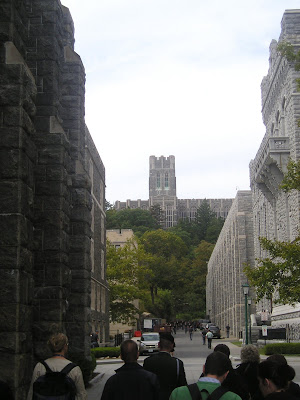
We got to visit Westpoint Academy as part of an optional add-on to the conference. It was a very different kind of college environment, given that every student is a future army officer. Still, the campus was pretty. That's the chapel you see in both the pictures.

I was looking forward to the fall colors in New Hampshire, but unfortunately, the leaves were only just starting to turn. It was also wet and rainy, which killed the idea of hiking in the mountains of Maine the weekend I was there. On the plus side, it was very pleasant running in the cool weather. And staying with my ecologist friend and her roommate really upped my awareness of what it means to be green. I mean, I think I'm more environmentally aware than most people and I try to keep my carbon footprint small, but these people compost their organic waste! And they subscribe to community supported agriculture schemes. 

Visiting Boston again reminded me of how much I love the city. It doesn't have the energy and excitement of New York, but there's something very civilized about this leafy college town. I had dinner with a friend in North End (Little Italy), which was one of the things I was looking forward to doing in Boston (this was my second trip). Here's a panaramic view of Copley Square on my last day there.

Friday, July 11, 2008

How I tour art galleries and art museums

I like visiting art galleries and art museums. But I haven’t always enjoyed them, which is ironic considering that I only started appreciating them after I had visited several in the course of much traveling.

Why was that? Well, because I did the typical kiasu Singaporean thing, which was to say I obsessively walked from painting to sculpture to artifact, all the while obsessively reading the little title plaques next to each item, and listening to the audio tour if I had one. I made sure to cover most the entire gallery or museum.

I ended up with ‘museum fatigue’, glancing at a lot of stuff, having very little impression of anything, getting very tired (those gallery and museum wings are huge) and on hindsight, wasting a lot of time and money (vacation time and admissions fees).

I still visit art galleries and museums when traveling. But after reflecting on my experiences, I have a different way of approaching them now.

For starters, I pick only the most promising one, or at most two, to go to in any city for one trip. There are more interesting things to do in the city, like walking its streets (I have flaneurose after all).

When I’m in the gallery or museum, I walk from room to room, but not from exhibit to exhibit. Instead, I walk to the center of each room and I take a long look around me, carefully taking each exhibit in for a few seconds each. If nothing catches my fancy, I move on to the next room. Only if something catches my eye and I want to take a closer look will I step forward to that exhibit.

[Incidentally, this is a good screen for works of ‘art’ I have never been able to ‘get’. I’m referring to paintings that are literally just a straight line across the canvas, or some such variety. Some of these are by modern artists as renowned as Joan Miró, but I can’t say that I actually understand them.]

Once I’m in front of an exhibit of interest, I’ll ignore the title plaque. Then I’ll carefully examine the painting or sculpture or artifact. Concentrate first on the details of the exhibit. Art is not reflective or introspective only, but is also sensual, in particular some art forms like sculpture. [Sculpture is meant to be touched, but all too often this is forbidden by museum curators.]

Only after you have observed and appreciated the finer details of the artwork will you be able to understand the intention of the artist.

Auguste Rodin’s The Thinker is a good example. Some people have a mistaken perception that The Thinker is in a pensive, contemplative mood.


But if you are perceptive, you will note the tension in The Thinker’s calf muscles, and the way his toes are clenched and how they grip the base of his seat. This is not the pose of a relaxed, contemplative thinker. It is the posture of someone in deep, intense, almost agitated concentration. The Thinker is, in a word, creating.

Once I have finished observing all the details, I think about what the artist was trying to portray. I think about the references or allusions he was trying to make (common in ancient or old art). In trying to come up with my own interpretation, I engage the artwork and the artist. I also try to guess what the title of the work is.

When I’m finished thinking about the work, I look at the title plaque for the first time and I read the title. This is also the point when I turn on the audio tour.

I’ve found that by following this process, I enjoy my visits to art galleries and museums a lot more. And even though I spend much less time on the premises, I feel each visit is more ‘complete’ and enriching, even though I probably see only a handful of exhibits. The difference is that each exhibit I see leaves a lasting impression on me.

Wednesday, June 4, 2008

Foreign currency during travel

Everyone knows that you need foreign currency when you travel. The question is, where do you get your foreign currency from?

Most people I speak to get the currency of their destination from moneychangers, either in Singapore or at their destination. In other words, they carry rather large amounts of cash while travelling, and they change currency on the street.

I get my foreign (or rather local) currency after I reach my destination, from a local ATM on the PLUS or Cirrus network.

There are a number of advantages to doing so: convenience, safety (particularly in those autobanking lobbies), zero likelihood of a con-job, and an ability to better control how much cash I draw or will spend. I almost never have leftover currency after a trip, other than coins, which I consider souvenirs of my trip.

The biggest problem most people have with this method of getting local currency is that they worry about bank charges, and that they feel the rate is inferior to the street rate. More to the point, the rate is not transparent (you won't know until your next bank statement) and hence, most people are wary of drawing local currency from an ATM.

On the other hand, the pro-ATM argument states that since the rate at which local currency is drawn from an ATM is the interbank rate, the rate should in fact be superior to the street rate, and even after deducting fees and charges, should be broadly comparable to the street rate. [The interbank rate is the wholesale rate at which forex transactions between banks are carried out through the interbank networks. In theory, the bid-ask spread should be narrower than the street rate due to the sheer volume of transactions.]

I believe in the pro-ATM argument, but after hearing so many people claim to the contrary, I decided to look into this myself. In the past month, I've made two trips, one to Taiwan on business and one to Bali for a vacation. For both trips, I drew local currency from ATMs multiple times and I checked my bank statements after I returned to Singapore. I computed the effective rates and compared them against the street rates I saw while in Bali. I didn't see any moneychangers in Taiwan while there, but I checked the rates on XE.com before my trip. Rates on XE.com really are the best rates you can get, XE being a forex broker. So any rate close to the XE rate is a really good rate.

Here's what I found:

In all cases, I drew currency using a Citibank ATM card, which according to the customer service officer I spoke to in Singapore, levies no charges on foreign ATM withdrawals. However, I was warned that the foreign bank that owns the ATM may choose to levy charges. 

Well, I saw no extra charges on my bank statement, so if there were charges, they were probably built into the exchange rates.

In Taiwan:

I drew NTD7900 from a Chinatrust ATM at Kaohsiung airport, and my statement recorded a withdrawal of SGD360.97. So the effective rate was SGD1 = NTD21.89. 
Not bad considering the XE rate was about just north of NTD22 to SGD1 at the time of my trip.

[Why did I draw such a funny number like NTD7900? To get the small NTD100 notes, duh.]

Incidentally, I also charged my ABN AMRO Switch card twice while in Taiwan.
The effective rates for those two purchases were SGD1 = NTD21.95 and SGD1 = NTD21.85. Both rates are comparable to drawing cash from an ATM.

In Bali:

The street rates in Kuta ranged from SGD1 = IDR6600 to SGD1 = IDR6800.
I drew local currency four times, from ATMS belonging to three different banks:
The effective rates were:

BNI bank at the airport: SGD1 = RUP6235
BII bank in Kuta: SGD1 = RUP6637
Citibank at the airport (after immigration but before customs; the only Citi ATM I saw while in Bali):
SGD1 = RUP6656

ABN AMRO Switch card purchase
SGD1 = IDR6601

The street rates in Bali were better, particularly when compared against the rate I got at BNI bank, which was clearly a rip-off. The fact that the BNI ATM was at the airport could be a factor though. More fees perhaps. The street rates were slightly better, but not substantially so, than the rate I got from BII bank in Kuta itself, and also the rate I got from the Citibank ATM at the airport (remember I used a Citicard to draw money).

From the above data, it also appears that it's cheaper to pay cash for purchases than to charge purchases to a credit card.

While the street rates appear to be better, I still think I'll rely on ATMs when I'm in Bali. Money changer scams in Bali are egregious. Just google for it and the horror stories will pop up. A slightly inferior rate is worthwhile insurance against con-artists.

So what's the conclusion to all this? My hypothesis is that the ATM rates are probably really good when you're drawing money in a developed country (which squares with my own experience back when I was a backpacking student in Europe), but street rates are probably better in developing or third world countries. Bear in mind that third world countries exhibit some peculiarities that probably account for this. For example, I've travelled to Peru and people there *love* US dollars, even if the dollar is going to the dogs in today's weakening US economy. And changing a single USD100 note compared to USD100 in smaller bills gives a better rate in many Southeast Asian countries (e.g. Thailand). It's no wonder that the street rates tend to be better than ATM rates. Still, this is balanced against exposing yourself to scams while changing money on the street.

Monday, June 2, 2008

Bali, May 2008

I went to Bali for the first time for a 9-day vacation in early May. It was supposed to be a 10-day vacation, but I changed my return flight to fly back early. It was without doubt, the least fun holiday I have ever taken. This marks the first time ever that I changed my return flight while on a vacation.

Bali's a nice enough place, I suppose, if you're into the surfing, lying-on-a-beach-getting-a-tan-with-a-bintang kind of vacation. It's also reasonably cheap, although I think the whole island of the gods on USD10 a day notion is a bit far-fetched. Being a terribly popular tourist location located in the exotic Far East, it's also stuffed with Australians, Europeans, Japanese, Koreans and increasingly, mainland Chinese (who I hear are also buying property in Bali).

Anyways, I didn't go to Bali for the surfing, the beach (Seminyak good, Kuta not so good, really), the diving, the massages (which were incidentally, great value), the food, or god forbid, the culture. My opinion is that if you've seen one temple/cathedral/mosque/torii, you're seen 'em all. In any case, I'm a flaneur by nature. Walking the streets is how I really get to know the feel of a place, and not just through visiting the canned tourist attractions. I once footed it from Canal Street to the Met when I was in Manhattan.

I went to Bali for one very simple reason: I wanted to learn how to paraglide, and Bali's the most convenient, accessible and reasonably priced location close to Singapore to learn how to do so. Seeing as how I knew no one else who wanted to throw themselves off a cliff (!), I travelled alone to Bali. Not an issue though; there are just some of us that have always dreamt of flying.

The learning site was at Timbis beach (more accurately, the cliff above Timbis beach that pilots step off after inflating the canopy), and the views were spectacular. Definitely not a part of Bali many tourists visit. The closest place to Timbis that most people would recognize is Nusa Dua, but in truth, Timbis is nowhere near Nusa Dua. It's actually closer to the temple at Pura Gunung Payung. Timbis lies along the southeastern edge of the Bukit peninsula.

The instructor was experienced, competent and safety conscious. Those are all good things. Unfortunately, he wasn't such a great teacher. There were of course practical handling lessons, but no theory or classroom lessons. We were just expected to read the textbook he gave us.

The real issue was the weather. Although I was there for nine days, I flew all of one day. That's right, one day. The instructor claimed that the weather wasn't typically so bad, that they would normally fly more than twenty days in a single month. But I wasn't so sure. I can personally attest that Bali is a great place to fly, if you already know how. But is it a great place to learn?

Beginner pilots can only fly in light, steady (non-gusty) winds of less than 15 mph. That by itself already doesn't happen consistently everywhere, not just Timbis in Bali. But what complicates matters at Timbis is that Timbis isn't a training hill. Instead, it's a cliff site that relies on sea breezes and ridge lift. That makes for spectacular views and pictures for sure, which is attractive to someone new to the sport. But what the splashy websites don't say is that while everyone takes off from the cliff, only advanced pilots are skilled enough to land back on the cliff (a difficult and dangerous feat for a beginner to attempt). In contrast, the beginners like me are supposed to take off from the cliff, but land on the beach at the foot of the cliff, where the L-Z is a long narrow stretch of sand (cushions falls, just in case). The problem is, at high tide, there is no beach.


Every morning I spent in Bali was spent bumming around in Kuta or Jimbaran, while waiting for the all-important phone call at about 3 o'clock in the afternoon telling us
(the other Singaporeans I met there and I) if the wind conditions were right for that day. Why 3 o'clock? Because that's when the tide starts to recede. And if wind conditions weren't right from 3 pm till 6:30 pm (when it gets dark), there would basically be no flying for that day. So we couldn't leave the vicinity of south Bali for a day trip anywhere (for instance, to Ubud) because we had to be available for the phone call, but there would be no guarantee of flying for that day even if we set the day aside. 

Both the wind and tide conditions have to be just right for student pilots in Bali. Most days, we spent the afternoons from 3pm onwards at the cliff, hoping for the winds to die down before it got dark, while more experienced pilots circled overhead. Most days, the wind didn't didn't die down. It wasn't very fun sitting there watching the instructor give tandem flights to the gawking tourists for USD75 a pop. I got so frustrated I cut my trip short and came home early.

While waiting for the winds to die down, I was entertained by stories by one of the Singaporeans (who apparently loves Bali enough to want to retire there) who saw, on her previous trip to Bali, a bunch of Filipinos and an American complete the entire 8 day course in one week.

I thought that was a fascinating story and how lucky indeed the Filipinos were! I was even kind enough not to point out that this was her fourth trip to Bali without completing the course. She's going to be back in Bali in August again, apparently on a month-long trip.

So, what's a landbound Singaporean with a yen for flying, living on an island where the national pastimes are really, let's face it, just eating, shopping and chillin', to do? Now that Bali's not really an option, I guess I'll just have to look for some place else that really does have reliable conditions for students.