Showing posts with label destinations. Show all posts

Sunday, June 13, 2010

Lake Maninjau FunFly 2010

I was out of town a few weeks ago for a paragliding event, and spent the last couple of weeks catching up on work after that.

Despite being in a scenic, culturally rich and diverse region, I've always found it somewhat surprising that most Singaporeans do not venture beyond a few familiar destinations for their holidays. Perhaps it has to do with not wanting to leave their comfort zone, or the desire for a fuss-free vacation, but most Singaporeans generally would limit themselves to Phuket, Bali, Bangkok, Hong Kong and a few other places. The more adventurous might head to the Indochina region or to places in the Philipines. And the favorite activities of Singaporean tourists are typically shopping and eating, which is something of a pity since that's pretty much what most Singaporeans do on weekends in Singapore too.

On some level, I can identify with Singaporeans on this, but fortunately, as a result of taking up paragliding, I've had my eyes opened to the diversity of the region. There are just so many great places to fly in the region and as a result of my flying habit, I've been pushed to explore the region a bit more thoroughly.

I travelled to Lake Maninjau on Sumatra, Indonesia, for the annual FunFly festival a few weeks ago. As a novice pilot, the range of sites suitable for me to fly is limited and I had been told that Lake Maninjau offered wonderful flying even for novices.

And it was wonderful indeed. I logged 8 flights and doubled my airtime to date. And met some wonderful people as well.

Lake Maninjau is diminutive, but a real gem of a lake. See for yourself. These are views from Puncak Lawang, the launch site. 

What made my holiday unusual was that the annual paragliding event is billed as an "International Festival", which is really just an excuse for the local Indonesian authorities to throw a big shebang of a party to get media coverage, increase tourism exposure, and get some facetime for the local officials. The pilots (all seven of us) were just the accessories for the event. Not that I wasn't bemused by it all. It was funny when the officials had clearly recycled their speeches from previous years, as there were obviously no pilots from Hong Kong this year, contrary to their grandiose speechs at the podium. For the record, there were 2 Singaporeans, a Malaysian, a German, an American, and 2 Australians this year. Here's a pic of the procession at the opening of the Festival.

It wasn't all flying at Lake Maninjau though; on days with bad weather, like fog for instance in the morning:

we did other things, like drive around the lake. The earthquake devastation from the Padang earthquake of 2009 was still evident in some places.

And relaxing by the lake in the evenings with a Bintang was simply great.

The hotel was built right by the lake, so going for a dip at anytime was no problem at all, though the water was far from clear. Kind of like swimming in an aquarium. All green and murky with fish everywhere.

But as far as a tourist destination goes, I have to say that Lake Maninjau, while beautiful, has much less to offer to the non-pilot. There are no other activities there other than flying, and even Internet access is to be found only in small roadside shops. Tellingly, none of the other pilots had brought their spouses or significant others with them. For destinations with activities for non-pilots, Phuket and Bali (typical Singaporean tourist destinations), are still better bets.

Notes for pilots:

I went to Maninjau in May and the weather was ok, though comments from other pilots had it that the weather was better the previous year. There was a fair bit of parawaiting, but that's par for the course in this sport. One has to pay one's dues on occasion. The season doesn't end in May but extends for a few more months. Contact Sumatra Paragliding for details.

Launch is from Puncak Lawang, about 1000 m above the lake, and is relatively easy, even for a novice like myself. The pics at the beginning of this post of the lake were taken from Puncak Lawang. The LZ is a grass patch, muddy in some places, demarcated by a road, the lakeshore, and fish ponds/rice paddies on the other two sides. It is fairly large and landing is generally ok when there is wind coming from the lake. When the wind is cross or when there is no wind, it can get a little tricky, but is still manageable. Note that the LZ lies beyond powerlines, so it is imperative to fly over the power lines first. It is generally a bad idea to cross back over the power lines once one is over the LZ. Altitude can be lost over the lake before the final approach. Below is a zoomed in view of the LZ from Puncak Lawang. It is the grass patch 2 o'clock from the 4 red-roofed houses in the centre of the pic.

The flying is mostly ridge soaring, but thermic flying is possible. The air can be bumpy in some places, but the flying is mostly safe. On good days, the air just got really lifty and it was possible to see the volcanoes behind the launch far in the distance. No pics for that though; I like my hands on the controls when I'm flying.

At the time of my visit, a new launch site was being developed as an alternative to Puncak Lawang. Here is a pic of the lake from the new launch site, a zoomed in view of the same LZ from the new launch site, and finally, a zoomed in view of the Puncak Lawang launch site from the new launch site. Note that Puncak Lawang in the pic is at the grass patch at the very top of the pic, bordered by trees. The open field slightly below it, bordering the winding road up the mountain, is an LZ suitable for top landing, for those with the requisite skills.

Getting there:

Tigerair used to have direct flights from Changi to Padang Minangkabau Airport, but these were discontinued during the Great Recession of 2009. No word on when flights will resume, but I'm not holding my breath. Airasia still flies to Padang from Kuala Lumpur, for those based in KL.

The most direct way to get to Lake Maninjau if you're based in Singapore is to take the Penguin ferry to Batam Centre from Harborfront, then a taxi from Batam Centre to Batam Hang Nadim Airport, then a flight to Padang on Mandala Airlines. From Padang, it's about a three hour drive to Maninjau. The total journey time takes something like 7-9 hours inclusive of waiting time, which is amazing when you consider that on an atlas, Maninjau and Singapore are sooo close to each other.

Tuesday, January 12, 2010

Nepal, Winter 2009, Part 2

[I haven't been posting as frequently as I should. Mainly because I have been catching up with work and stuff post-vacation and Dragon Age: Origins has been taking up an inordinate amount of my time.]

Durbar Square in Kathmandu was a riot of sound and color. I took a few pictures, which show the large, brightly colored temples. However, the pictures don't convey the sounds of vehicle honks (which are permitted to pass through the square), the blaring of temple music, gongs and bells, and the cacophony of streams of people coming and going.


The most interesting building in Durbar Square is without question the Kumari Bahal, the home of the Kumari Devi, the living goddess.

The most evident thing upon crossing the threshold into the courtyard of the Kumari Bahal is the quiet.


Away from the hustle and bustle of Durbar Square, the courtyard prompts introspection and contemplation. The second thing that catches the visitor's eye are the very fine carvings surrounding the courtyard.

I felt that the Kumari Bahal was unique in 2 respects. The first is that the Bahal itself is a place of residence rather than a temple serving a purely ceremonial function. People actually live in the Bahal, and it was evident because instead of crowds of worshippers and devotees, I saw a few women carrying platters and wash basins and other household objects as they moved in the compound, all the while speaking in hushed voices.

Second, because of her divine status, it's not a stretch to say that the Royal Kumari's movement is curtailed. The Bahal is as much prison as palace, and I took a picture from just inside the doorway to capture what it was like to see the outside world from within the Bahal.


After 2 days of walking in Kathmandu, I was ready to carry on with my journey. I left Kathmandu on 10 December, and my schedule required me to be in Pokhara by the night of the 13th. So I decided to pack in a short 2-day whitewater rafting trip en route to Pokhara followed by an overnight stay in a small mountain village called Bandipur.

I joined a rafting tour organized by the professionally run Himalayan Encounters on the Trisuli River.

I have no pictures of this part of my trip (well, maybe just one) as it was uneventful (in the fun sense).

First of all, I chose the rafting trip on the Trisuli as it was a short trip and the Trisuli runs alongside the highway from Kathmandu to Pokhara. This removed the requirement for a 7-hour continuous bus ride to Pokhara, but it did mean that we never did escape the sound of traffic; that kind of spoilt the illusion that we were rafting in the wilderness.

The Trisuli in December was … sedate to say the least. There were some exciting moments, but it was primarily a relaxing float. I’m certainly not doing this again.

However, what made the trip unpleasant was that I fell sick after the first night (note to self: never take raw salad unless you are sure the restaurant is fastidious with their washing water). I did manage to complete the trip despite my heaving stomach, but it wasn’t easy.

We stayed in a small pretty village called Bandipur for one night at the conclusion of the rafting portion of the trip. Here’s a picture of the courtyard of the Old Inn at Bandipur where we stayed.


I think I would have appreciated it more if I hadn’t still been sick, but fortunately I got better in the morning after I had voided my system completely.

The company was sorely lacking I’m sad to report. I rafted with a group of 5 women who had each individually signed up for a multi-day tour and met up in Kathmandu, the Nepal portion of the trip of which was organized by Himalayan Encounters. Things started out well enough in the beginning as most of them were friendly but the company wore increasingly thin as the trip continued.

I mean, what do you call someone who throughout the three days, doesn’t introduce herself when I was exchanging names with everyone or address you directly except with a generic “Could you pass the honey please” in my general direction. That was one of the Canadians for you. I could understand why the Belgian girl spoke very little, since her English was poor, but the Canadian was quite patently unfriendly.

I got steadily excluded after I became sick; nobody wants to keep company with the miserable. [Although that apparently didn’t stop the Canadian from going “I’ll eat it” after the tour guide advised me to abstain from the honey fritters served at dinner. How sensitive of her.] I felt like the odd man out, which wasn’t entirely unexpected as I was the only man in the group.

As professionally run as Himalayan Encounters was, I felt that I was treated somewhat differently by the tour guides (with the exception of the rafting guide) and inn operators. Perhaps it was because the other guests were all ladies, or to the point, Caucasian (preferential treatment for white tourists, anyone?), or that I signed up only for a small portion of their multi-day tour package fairly late when I reached Kathmandu. What was certainly evident was that I ended up with the worst room in the inn at Bandipur (completely windowless), and a small kerfuffle where they assumed that I was staying 2 nights in Bandipur instead of 1 night, wherein I suspect that I had been overcharged. Eventually, I stayed only 1 night, but I suspect that the original price was for 2 nights. No refund was offered. I didn’t press the issue as the receipt I was issued said 1 night, but the price for the Old Inn in Bandipur as listed in Lonely Planet indicated that the price I paid would have been for 2 nights.

It wasn’t too bad of an experience, all things considered. Himalayan Encounters still got me to Pokhara safely and without incident. And some parts of the rafting trip were fun. But knowing what I know now, I think I would have given that trip a pass were I to make the decision again.

Next post: Paragliding in Pokhara.

Tuesday, January 5, 2010

Nepal, Winter 2009, Part 1

I traveled to Nepal in December 2009 for my vacation. It was my first trip to Nepal. This will be the first of a multi-part series on my experiences and reflections from the trip. Apologies to those expecting incisive political discourse or criticism, I won't be blogging on those for quite a while. Not unless there is something that utterly demands my attention.

[And to site administrators who manage aggregator websites (like say Singapore Daily), I would appreciate it if you did NOT link to these posts. The content is somewhat personal.]

I arrived in Kathmandu in early December. Tribhuvan International Airport was, as expected, fairly dilapidated, and there were hordes of touts at the exit of the arrival hall. Again, an expected occurrence.

It was when I got into the car of my hotel pick-up from the airport and started the drive into Kathmandu proper that I got my first real impression of Kathmandu.

The immediate impression was undeniably that of a city in a third-world country. Poverty was certainly evident: garbage was strewn everywhere (and I learnt later that a lot of it was piled up and burnt each night by the homeless), there were beggars and street hawkers scraping out a living from the streets, and the buildings were blocky and worn down. Traffic was heavy; it took about 40 minutes to get to my hotel. The air was heavily polluted with exhaust fumes, and the streets were a cacophony of incessant car honks. The roads naturally, were full of pot-holes, and pedestrians scrambled along the same roads the as the vehicles. All in all, as the hotel manager of the Hyatt Regency in Kathmandu (whom I met later on my trip) put it, Kathmandu was a "disaster".

[Did I mention the pollution? To put it in the earthiest terms possible, snot that emerges from one's nostrils each day is colored black. Yes, black. Imagine what goes into the lungs each day.]

Not that I had a pejorative opinion of the city. I knew that Nepal was overwhelmingly poor before I traveled there, and had adjusted my expectations accordingly. Still, coming from Singapore, Kathmandu was a bit of a sensory overload.

I stayed in a district called Paknajol during my 2 nights in Kathmandu, northwest of the tourist district of Thamel. It was a deliberate decision on my part as I can't abide staying in a noisy district while traveling. I'm not exactly the partying-till-late-and-getting-wasted sort.

This is Thamel:


This is Paknajol:


After I had settled into my hotel room, it was just a couple of hours till nightfall and dinner. I have no problems traveling alone, but I generally do not like taking my meals alone. Walking into a restaurant and saying "Table for one" is probably one of my least favorite things to do while traveling. As luck would have it, I met three ladies on the airplane to Kathmandu, recognized their Singaporean accents, and asked if they would like to have dinner together that night. Well, actually, it was more like I imposed myself on them. Anyways, it turned out that they were all teachers and were in Nepal on a trekking trip; one had apparently come to Nepal every year for the past 8 years.

We had Italian food for dinner that night. Unlike most Singaporeans, I'm not a avid photographer of gastrop0rn, but here's a pretty picture of the antipasti platter we had:


I parted ways with the teachers after that night, and being the flaneur that I am, I spent the following day walking around Kathmandu. Most of my time was spent walking in and around Thamel and Durbar Square.

Kathmandu reminded me of a number of different places that I had been to before. The strongest first impression was that it reminded me of Cuzco, Peru. The poverty of the city, and the importance of trekking and mountaineering tourism, so evident in the Thamel district, and how the local people are employed as guides and porters, gave me that overwhelming parallel impression. In Cuzco, the Andean mountains and Machu Picchu are the big draws. In Nepal, tourists come for the Himalaya and Everest.

Kathmandu also quite unexpectedly reminded me of two other places: Bali and Tokyo.

The Bali connection is easily explained: Nepal's religious culture is a curious mix of Hinduism and Buddhism, and the prevalence of roadside shrines in Nepal, where offerings (such as marigold petals) are made recalls the practice of canang sari in Bali. Here's a roadside shrine in Kathmandu:


The Tokyo connection is less obvious. How does Kathmandu resemble Tokyo?

I visited Tokyo a few years ago, right after watching Lost in Translation. Now watching a movie or reading a book set in a particular city before visiting it is sure to color your perceptions of that city. Tokyo was no different. Just as I am a fan of Pedro Almodovar and speak some Spanish, my perception of Madrid is quite a bit different from the average Singaporean who knows little of Spain.

To cut things short since this post is really about Kathmandu and not Tokyo, what struck me most about Tokyo was the juxtaposition of the ancient with the modern, the traditional with the progressive. Tokyo was a city of skyscrapers and city towers as much as it was a city of quiet temples, tea houses and ryokan. Kathmandu is no different in this respect. It is a modern, if poor, city, but with crumbling, centuries-old temples, shrines, stupas and relics.

The Lonely Planet guidebook that I toted around in my backpack described Kathmandu well. Kathmandu does indeed have an ancient mystique that has captivated and fascinated travelers for centuries. Perhaps the best description of this was how the writers of the guidebook wrote of how, in Nepal, it is not at all remarkable to find in a household a centuries old statue used as a prop to hold up a broken shelf or as a support for a clothesline.

Clearly, Kathmandu isn't a modern city built upon the ruins of an older one, but more like a modern city layered upon the still vibrant and living culture of a far older city. As an example, this is an antique, ornate carved wooden window, found right above a photocopy shop.

It was mentioned in a walking tour in the guidebook, and in this I have to agree with the guidebook. The sublime is paired with the quotidian, in a incongruous juxtaposition. That is part of Kathmandu's, and Nepal's, unique charm.

Here is another example: a stupa in a small square that is also a street market. Again, the divine is placed squarely next to the earthly, or in this case, mercantile.

Perhaps the clearest example of Nepal's living ancient culture is how Nepalis habitually touch relics or shrines whenever they past by them. Typically, a Nepali would touch the shrine and then raise their fingers to their lips, all the time mouthing a silent prayer. It is a gesture not unlike Catholics crossing themselves. I waited only a few minutes to capture this picture, and I am glad I did because it captures so perfectly the relationship that Nepalis have with their religion and their culture.


Next post: Kathmandu's Durbar Square, and my route to Pokhara.

Sunday, September 6, 2009

Kawagoe, Reinventing Lego, Design Thinking

In a departure from reproducing stories in full (which I think actually contravenes fair use policy, shame on me!), I'm only providing the links to 3 interesting stories I read today.


Kawagoe - The vanished Edo


Reinventing Lego - An inspiring business turnaround (and one of the few toys NOT made in China)


Design Thinking - relevant to my job today

Monday, December 15, 2008

"Le Tour du Chocolat"

In anticipation of a future trip to Paris..., the full article with multimedia content is here.

From The New York Times
By AMY THOMAS
Published: December 14, 2008


THE French have elevated many things to high art: fashion, flirting, foie gras. Chocolate is no exception. With boutiques that display truffles as rapturously as diamonds, the experience of visiting a Parisian chocolatier can be sublime.

The problem, of course, is squeezing in as many of these indulgent visits as possible while also giving the rest of the city its due. My solution: devote one full day to chocolate boutiques, and do it in style. So, on my last visit to Paris, I took to the city’s Vélib’ bike system and mastered a two-wheeled circuit of eight of the chocolatiers that had the best reputations and most glowing reviews in city guidebooks and online message boards. It was exhilarating and exhausting, not to mention decadent. It was a chocoholic’s dream ride.

The Vélib’s — industrial-looking road bikes that are already icons of Parisian-chic just a year and a half after the city initiated the program — made the moveable feast more fun. Progressing from pralines to pavés, I spun by the Eiffel Tower, zipped across the Seine and careened through the spindly streets of St.-Germain-des-Prés alongside other bikers: Parisians in summer dresses and business suits, their front baskets toting briefcases, baguettes and sometimes even Jack Russell terriers. 

Practically speaking, the bikes were all but essential. How else could I cover five arrondissements in as many hours, while simultaneously countering a day of debaucherous extremes?

The hedonism began in the center of town with the oldest master on my list, Michel Cluizel (201, rue St.-Honoré; 33-1-42-44-11-66; www.chocolatmichelcluizel-na.com), who has been making chocolate since 1948. A short distance from a Vélib’ station at the intersection of Rues de l’Echelle and St-Honoré, I passed luxury stores flaunting billowy gowns and four-inch Mary Janes and stepped inside what was just as divine: a store where molten chocolate spews from a fountain and the shelves are stocked with bars containing as much as 99 percent cacao. 

Mr. Cluizel has a single American outpost, in Manhattan, at which I’ve indulged in hot cocoa made with a blend of five cocoa beans. At his Parisian shop, managed by his daughter Catherine, I discovered the macarolat (1.55 euros, or about $2 at $1.29 to the euro). A chocolate version of the macaroon, it has a dark chocolate shell filled with almond and hazelnut praline, the nuts ground coarsely to give a rich, grainy texture. It was two bites that combined creamy and crunchy, snap and subtlety. But it was just two bites; I wanted more.

A quick spin west landed me at the doors of Jean-Paul Hévin (231, rue St-Honoré, (33-1-55-35-35-96; www.jphevin.com). A modern blend of dark wood cabinetry, slate floors and backlit wall cubbies where cobalt-accented boxes of bonbons are displayed, the space would feel intimidating if not for the shopkeepers, who are both numerous and gracious as they juggle the crowds ogling mango coriander macaroons and Pyramide cakes. After considerable debate — would it be ridiculously gluttonous to have a “choco passion,” a cocoa cake with chocolate mousse, chocolate ganache and praline puff pastry, so early in the day? — I settled on a caramel bûche (3.20 euros). Larger than an individual bonbon but smaller than a Hershey bar, the silky caramel enrobed in delicate dark chocolate hit the sweet spot.

With the choco-salty taste lingering on my tongue, I picked up a bike outside the Hôtel Costes, craning my neck to spy any A-listers — were Sting and Trudie in there? Beyoncé and Jay-Z? — and set out for the 16th Arrondissement.

Just beyond the Place de la Concorde I veered onto Avenue Gabriel. It is a curving street that winds past both the United States Embassy and Pierre Cardin’s showcase for young artists, Espace, before eventually turning into a narrow cafe-lined passage where you have to weave around double-parked delivery trucks. Hoping to avoid throngs of wide-eyed tourists on the parallel Champs-Élysées and cars haphazardly zigging and zagging on the rotary around the Arc de Triomphe, I took the residential backstreets to Avenue Victor Hugo.

It was on this street that I found the most eccentric chocolatier on my list: Patrick Roger (45, avenue Victor Hugo; 33-1-45-01-66-71; www.patrickroger.com). It’s not just the chocolate sculptures (a life-size farmer, for example), seasonal window displays (a family of penguins, also life-size) or snazzy aquamarine packaging he’s known for: his intensely flavored bonbons are as bold as they come. 

“I do think Patrick Roger is outstanding since he combines new, unusual flavors,” said David Lebovitz, an American chocolate connoisseur, author of “The Great Book of Chocolate” and a Paris resident. But, he added, Mr. Rogers “isn’t doing weird flavors just to be trendy, like others tend to do in Paris nowadays.” 

I sampled a few to confirm. The Jamaica has a rich coffee flavor from ground Arabica coffee beans; the Jacarepagua blends sharp lemon curd and fresh mint, and then there’s the Phantasme, made with ... oatmeal. Each costs less than 1 euro. 

About 90 minutes in, I had tasted creamy, salty and tart and had traversed a good stretch of the city. I was high — on Paris and sugar — coasting beneath Avenue Kléber’s towering chestnut and plane trees toward the Place du Trocadéro in the 16th Arrondissement. Winding my way down the steep hills of the Rue Benjamin Franklin and the Boulevard Delessert, past romantic cafes and limestone edifices, alternately beige and gray depending on the light, I felt as though I was in a quaint Gallic village, not the capital city. That is until I was spit out across the river from the grandest Parisian landmark of all: the Eiffel Tower.

Digital cameras flashed, souvenirs were hawked and regiments of tour buses idled in one big mechanical whir. It was as if every foreigner had descended on the monument at that very moment. I didn’t exhale until I entered the quietly sophisticated Seventh Arrondissement.

Michel Chaudun (149, rue de l’Université, 33-1-47-53-74-40) is wildly talented as an artist and chocolate sculptor (his watercolors decorate the store along with chocolate Fabergé eggs and African statues), to say nothing of his reputation for being one of the world’s best chocolatiers. After 22 years of turning cacao into sublime bonbons, he’s responsible for influencing many of the city’s newer generation of chocolatiers. 

His pavés are particularly worshipped. They’re sugar cube-size squares of cocoa-dusted ganache that you deftly spear from the box with a toothpick and then allow to melt a little on your tongue a little before biting into the rich creaminess. Fresh and luscious, they’re also hypersensitive to warm temperatures. Which meant — tant pis — if I tried to save any for later, they would wind up a choco-puddle. 

Hopping on and off the Vélib’s so often courted a certain amount of trouble. Parisian cynicism reared its head when a disgusted man at a station told me that 90 percent of the bikes don’t work. I wouldn’t say the defective bicycles were that frequent, but I learned an essential checklist: Are the tires inflated? The rims, straight? Is the front basket intact? Do the gears work? Is the chain attached? With these things checked, you’re good to go, as I was after savoring the last pavé from my modest box of six (3.40 euros).

Cutting across the square fields in front of Les Invalides I glided by college students throwing Frisbees and old men playing pétanque. To my right, the gilded dome of Les Invalides; to my left, more gold crowning the ornate Alexandre III bridge. This was a decadent journey indeed.

Finally, in the Sixth Arrondissement, it seemed I could toss an M & M in any direction and hit a world-class chocolatier. There was the whimsical Jean-Charles Rochoux (16, rue d’Assas, 33-1-42-84-29-45; www.jcrochoux.fr), where gaudy chocolate sculptures of garden gnomes belie the serious artistry of his Maker’s Mark truffles. 

Christian Constant (37, rue d’Assas, 33-1-53-63-15-15), a Michelin-starred chef and award-winning chocolatier, excels at such spicy and floral notes as saffron and ylang-ylang. Pierre Marcolini (89, rue de Seine, 33-1-4407-3907; www.marcolini.be), the lone Belgian of the group, offers 75 percent dark chocolate from seven South American and African regions. Buzzing, I intended to finish the circuit in grand style.

The line snaking out of Pierre Hermé’s slim boutique (72, rue Bonaparte, 33-1-43-54-47-77; www.pierreherme.com) told me I was doing the right thing. When I made it inside the snapping automatic doors, it was (forgive me!) like being a kid in a candy store: pristine rows of cakes adorned with fresh berries, coffee beans and dark chocolate shavings.

“Un Plénitude, s’il vous plait.” 

I took my treasure to a nearby park and tucked into the dome-shaped cake filled with chocolate mousse and ganache, crunchy caramel and fleur de sel. I relished the fluffy whipped richness, the bite of dark chocolate and the tang of salt. Had I died and gone to heaven? No, it was just a rapturous day in the City of Light and dark chocolate. 

PEDALING FOR PAVÉS

After doubling the number bicycles since the program started last summer to 20,600, Paris’ Vélib’’ (www.velib.paris.fr) is now the largest free bike program in France. There are 1,451 stations in the city, or one approximately every 900 feet. Each station has about 15 to 20 bikes. The bikes are simple: three speeds, an adjustable seat, a bell and basket and a headlight. 

By purchasing a one-day or weeklong pass at the kiosk located at a station, you can hop on any bicycle and drop it at your next destination. To unlock a bike, you punch in your personal access code at the kiosk.

Though it’s called a free bike program (Vélib’ is short for vélo libre, or free bike), a day pass costs 1 euro. The first half-hour on the bike is no additional charge, the second half-hour is 1 euro, and the third half-hour is 2 euros. After that, it’s 4 euros every half-hour. The shorter your trips, the lower the cost. My total cost for five hours was 12.60 euros, or about $16.15 at $1.29 to the euro.


Monday, November 3, 2008

Recent trip

I had a trip recently and I guess I should make a point of blogging about it, if only for my own record.

I recently attended a science conference in New York, followed by a short vacation visiting friends in New Hampshire and Boston. It was an interesting time: for example, I was invited to a friend of a friend's place to watch the first presidential nominee debate on TV, with all the requisite moaning and bitching about McCain after (it was a Democrat household). I already knew Americans are political, given that I went to college in the United States, but it was refreshing to encounter once again that kind of passion about politics that is seldom seen in staid old Singapore.

Anyways, America decides tomorrow and it's big big news seeing as how the POTUS affects the whole world.

New York City was wonderful. I mean, obviously. It's NYC. I *heart* New York and all that, this being my 4th trip to New York. Here's a pic, a bit blurry, from my hotel room at Sheraton Suites on the Hudson. Yes, we stayed in New Jersey cos it was a little cheaper and the commute really wasn't that bad, what with the water taxi and all.

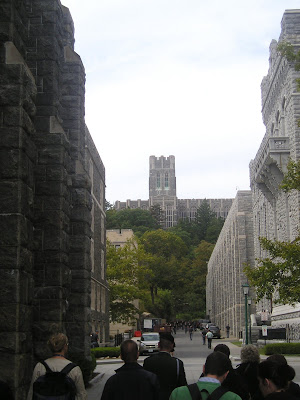
We got to visit Westpoint Academy as part of an optional add-on to the conference. It was a very different kind of college environment, given that every student is a future army officer. Still, the campus was pretty. That's the chapel you see in both the pictures.

I was looking forward to the fall colors in New Hampshire, but unfortunately, the leaves were only just starting to turn. It was also wet and rainy, which killed the idea of hiking in the mountains of Maine the weekend I was there. On the plus side, it was very pleasant running in the cool weather. And staying with my ecologist friend and her roommate really upped my awareness of what it means to be green. I mean, I think I'm more environmentally aware than most people and I try to keep my carbon footprint small, but these people compost their organic waste! And they subscribe to community supported agriculture schemes. 

Visiting Boston again reminded me of how much I love the city. It doesn't have the energy and excitement of New York, but there's something very civilized about this leafy college town. I had dinner with a friend in North End (Little Italy), which was one of the things I was looking forward to doing in Boston (this was my second trip). Here's a panaramic view of Copley Square on my last day there.

Wednesday, June 4, 2008

Foreign currency during travel

Everyone knows that you need foreign currency when you travel. The question is, where do you get your foreign currency from?

Most people I speak to get the currency of their destination from moneychangers, either in Singapore or at their destination. In other words, they carry rather large amounts of cash while travelling, and they change currency on the street.

I get my foreign (or rather local) currency after I reach my destination, from a local ATM on the PLUS or Cirrus network.

There are a number of advantages to doing so: convenience, safety (particularly in those autobanking lobbies), zero likelihood of a con-job, and an ability to better control how much cash I draw or will spend. I almost never have leftover currency after a trip, other than coins, which I consider souvenirs of my trip.

The biggest problem most people have with this method of getting local currency is that they worry about bank charges, and that they feel the rate is inferior to the street rate. More to the point, the rate is not transparent (you won't know until your next bank statement) and hence, most people are wary of drawing local currency from an ATM.

On the other hand, the pro-ATM argument states that since the rate at which local currency is drawn from an ATM is the interbank rate, the rate should in fact be superior to the street rate, and even after deducting fees and charges, should be broadly comparable to the street rate. [The interbank rate is the wholesale rate at which forex transactions between banks are carried out through the interbank networks. In theory, the bid-ask spread should be narrower than the street rate due to the sheer volume of transactions.]

I believe in the pro-ATM argument, but after hearing so many people claim to the contrary, I decided to look into this myself. In the past month, I've made two trips, one to Taiwan on business and one to Bali for a vacation. For both trips, I drew local currency from ATMs multiple times and I checked my bank statements after I returned to Singapore. I computed the effective rates and compared them against the street rates I saw while in Bali. I didn't see any moneychangers in Taiwan while there, but I checked the rates on XE.com before my trip. Rates on XE.com really are the best rates you can get, XE being a forex broker. So any rate close to the XE rate is a really good rate.

Here's what I found:

In all cases, I drew currency using a Citibank ATM card, which according to the customer service officer I spoke to in Singapore, levies no charges on foreign ATM withdrawals. However, I was warned that the foreign bank that owns the ATM may choose to levy charges. 

Well, I saw no extra charges on my bank statement, so if there were charges, they were probably built into the exchange rates.

In Taiwan:

I drew NTD7900 from a Chinatrust ATM at Kaohsiung airport, and my statement recorded a withdrawal of SGD360.97. So the effective rate was SGD1 = NTD21.89. 
Not bad considering the XE rate was about just north of NTD22 to SGD1 at the time of my trip.

[Why did I draw such a funny number like NTD7900? To get the small NTD100 notes, duh.]

Incidentally, I also charged my ABN AMRO Switch card twice while in Taiwan.
The effective rates for those two purchases were SGD1 = NTD21.95 and SGD1 = NTD21.85. Both rates are comparable to drawing cash from an ATM.

In Bali:

The street rates in Kuta ranged from SGD1 = IDR6600 to SGD1 = IDR6800.
I drew local currency four times, from ATMS belonging to three different banks:
The effective rates were:

BNI bank at the airport: SGD1 = RUP6235
BII bank in Kuta: SGD1 = RUP6637
Citibank at the airport (after immigration but before customs; the only Citi ATM I saw while in Bali):
SGD1 = RUP6656

ABN AMRO Switch card purchase
SGD1 = IDR6601

The street rates in Bali were better, particularly when compared against the rate I got at BNI bank, which was clearly a rip-off. The fact that the BNI ATM was at the airport could be a factor though. More fees perhaps. The street rates were slightly better, but not substantially so, than the rate I got from BII bank in Kuta itself, and also the rate I got from the Citibank ATM at the airport (remember I used a Citicard to draw money).

From the above data, it also appears that it's cheaper to pay cash for purchases than to charge purchases to a credit card.

While the street rates appear to be better, I still think I'll rely on ATMs when I'm in Bali. Money changer scams in Bali are egregious. Just google for it and the horror stories will pop up. A slightly inferior rate is worthwhile insurance against con-artists.

So what's the conclusion to all this? My hypothesis is that the ATM rates are probably really good when you're drawing money in a developed country (which squares with my own experience back when I was a backpacking student in Europe), but street rates are probably better in developing or third world countries. Bear in mind that third world countries exhibit some peculiarities that probably account for this. For example, I've travelled to Peru and people there *love* US dollars, even if the dollar is going to the dogs in today's weakening US economy. And changing a single USD100 note compared to USD100 in smaller bills gives a better rate in many Southeast Asian countries (e.g. Thailand). It's no wonder that the street rates tend to be better than ATM rates. Still, this is balanced against exposing yourself to scams while changing money on the street.

Monday, June 2, 2008

Bali, May 2008

I went to Bali for the first time for a 9-day vacation in early May. It was supposed to be a 10-day vacation, but I changed my return flight to fly back early. It was without doubt, the least fun holiday I have ever taken. This marks the first time ever that I changed my return flight while on a vacation.

Bali's a nice enough place, I suppose, if you're into the surfing, lying-on-a-beach-getting-a-tan-with-a-bintang kind of vacation. It's also reasonably cheap, although I think the whole island of the gods on USD10 a day notion is a bit far-fetched. Being a terribly popular tourist location located in the exotic Far East, it's also stuffed with Australians, Europeans, Japanese, Koreans and increasingly, mainland Chinese (who I hear are also buying property in Bali).

Anyways, I didn't go to Bali for the surfing, the beach (Seminyak good, Kuta not so good, really), the diving, the massages (which were incidentally, great value), the food, or god forbid, the culture. My opinion is that if you've seen one temple/cathedral/mosque/torii, you're seen 'em all. In any case, I'm a flaneur by nature. Walking the streets is how I really get to know the feel of a place, and not just through visiting the canned tourist attractions. I once footed it from Canal Street to the Met when I was in Manhattan.

I went to Bali for one very simple reason: I wanted to learn how to paraglide, and Bali's the most convenient, accessible and reasonably priced location close to Singapore to learn how to do so. Seeing as how I knew no one else who wanted to throw themselves off a cliff (!), I travelled alone to Bali. Not an issue though; there are just some of us that have always dreamt of flying.

The learning site was at Timbis beach (more accurately, the cliff above Timbis beach that pilots step off after inflating the canopy), and the views were spectacular. Definitely not a part of Bali many tourists visit. The closest place to Timbis that most people would recognize is Nusa Dua, but in truth, Timbis is nowhere near Nusa Dua. It's actually closer to the temple at Pura Gunung Payung. Timbis lies along the southeastern edge of the Bukit peninsula.

The instructor was experienced, competent and safety conscious. Those are all good things. Unfortunately, he wasn't such a great teacher. There were of course practical handling lessons, but no theory or classroom lessons. We were just expected to read the textbook he gave us.

The real issue was the weather. Although I was there for nine days, I flew all of one day. That's right, one day. The instructor claimed that the weather wasn't typically so bad, that they would normally fly more than twenty days in a single month. But I wasn't so sure. I can personally attest that Bali is a great place to fly, if you already know how. But is it a great place to learn?

Beginner pilots can only fly in light, steady (non-gusty) winds of less than 15 mph. That by itself already doesn't happen consistently everywhere, not just Timbis in Bali. But what complicates matters at Timbis is that Timbis isn't a training hill. Instead, it's a cliff site that relies on sea breezes and ridge lift. That makes for spectacular views and pictures for sure, which is attractive to someone new to the sport. But what the splashy websites don't say is that while everyone takes off from the cliff, only advanced pilots are skilled enough to land back on the cliff (a difficult and dangerous feat for a beginner to attempt). In contrast, the beginners like me are supposed to take off from the cliff, but land on the beach at the foot of the cliff, where the L-Z is a long narrow stretch of sand (cushions falls, just in case). The problem is, at high tide, there is no beach.


Every morning I spent in Bali was spent bumming around in Kuta or Jimbaran, while waiting for the all-important phone call at about 3 o'clock in the afternoon telling us
(the other Singaporeans I met there and I) if the wind conditions were right for that day. Why 3 o'clock? Because that's when the tide starts to recede. And if wind conditions weren't right from 3 pm till 6:30 pm (when it gets dark), there would basically be no flying for that day. So we couldn't leave the vicinity of south Bali for a day trip anywhere (for instance, to Ubud) because we had to be available for the phone call, but there would be no guarantee of flying for that day even if we set the day aside. 

Both the wind and tide conditions have to be just right for student pilots in Bali. Most days, we spent the afternoons from 3pm onwards at the cliff, hoping for the winds to die down before it got dark, while more experienced pilots circled overhead. Most days, the wind didn't didn't die down. It wasn't very fun sitting there watching the instructor give tandem flights to the gawking tourists for USD75 a pop. I got so frustrated I cut my trip short and came home early.

While waiting for the winds to die down, I was entertained by stories by one of the Singaporeans (who apparently loves Bali enough to want to retire there) who saw, on her previous trip to Bali, a bunch of Filipinos and an American complete the entire 8 day course in one week.

I thought that was a fascinating story and how lucky indeed the Filipinos were! I was even kind enough not to point out that this was her fourth trip to Bali without completing the course. She's going to be back in Bali in August again, apparently on a month-long trip.

So, what's a landbound Singaporean with a yen for flying, living on an island where the national pastimes are really, let's face it, just eating, shopping and chillin', to do? Now that Bali's not really an option, I guess I'll just have to look for some place else that really does have reliable conditions for students.